The winner of the 2026 ASN Presidential Award, chosen from among all of the papers published in The American Naturalist in 2025, is “Accelerated Phenology Fails to Buffer Fitness Loss from Delayed Rain Onset in a Clade of Wildflowers” by Samantha J. Worthy, Sarah R. Ashlock, Arquel Miller, Julin N. Maloof, Sharon Y. Strauss, Jennifer R. Gremer, and Johanna Schmitt (205: 485-501). Congratulations!
2026 ASN Presidential Award
Posted on
by
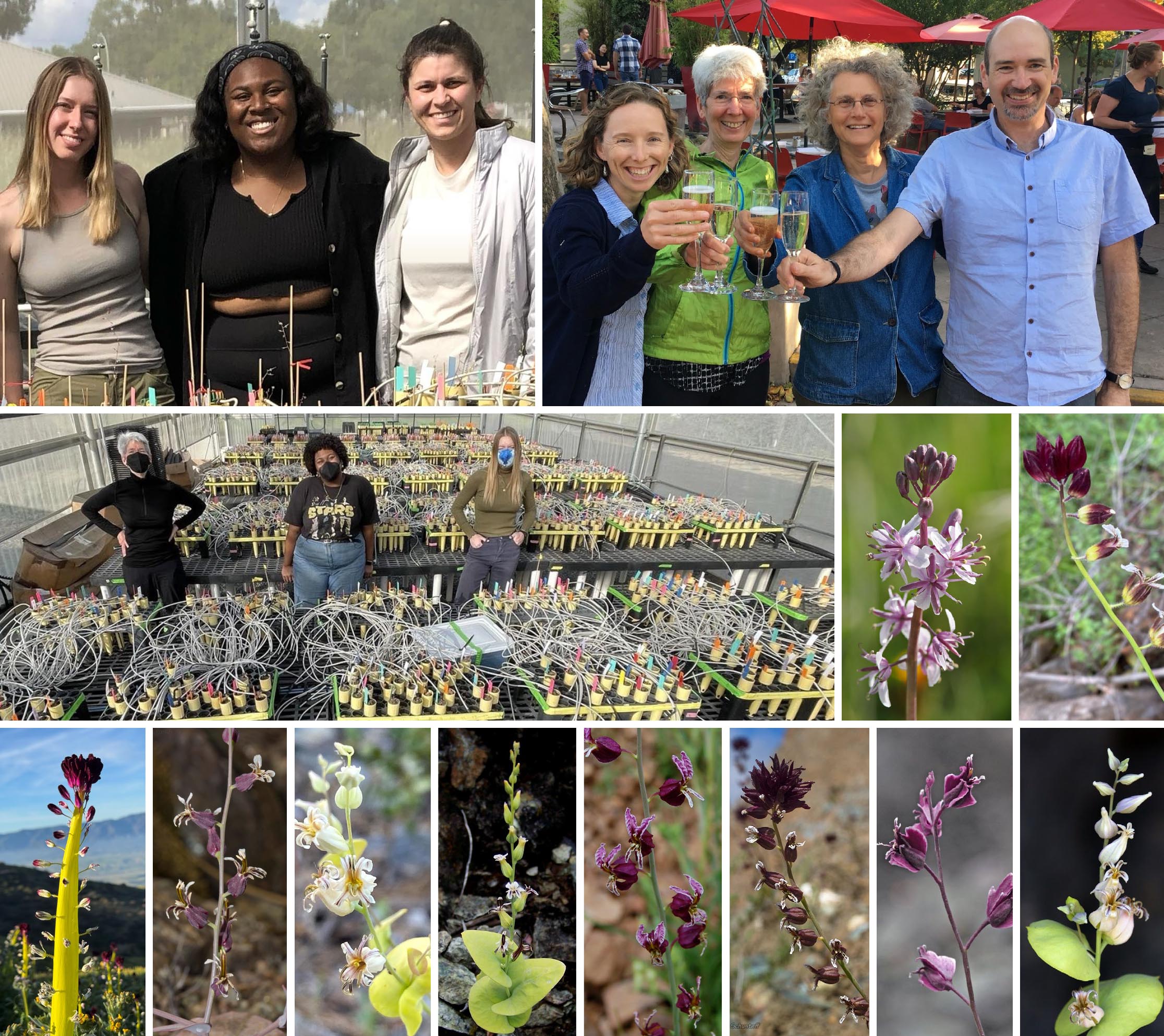
Phenotypic plasticity looms large in our ability to understand and predict the persistence of species in nature. In this study, the authors tested the extent to which phenotypic plasticity buffers fitness in a clade of ten winter annual wildflowers. In Mediterranean climates in California, fall rains (which trigger germination in many plants) are arriving later with climate change, resulting in shorter growing seasons. When faced with delayed rains (and delayed germination), many plants will develop faster and flower at a smaller size to buffer flowering timing. In this data rich study, the authors experimentally manipulated germination timing and then raised plants outside under semi-natural conditions. They found that plants decreased time to flowering as a response to delayed germination and that some species flowered at a smaller size. They also found that – while rapid development and decreased time to flowering appears to be adaptive – it was not enough to buffer plants from the decreased fitness effects of delayed germination. Finally, the authors found that the degree of plasticity had diverged across the clade of wildflowers with species in novel, wet environments showing higher levels of plasticity than species from the desert environment, which is the ancestral condition. This paper is an excellent contribution to The American Naturalist. It has a strong conceptual motivation and clear conservation relevance, and it focuses on diversity in hard-to-measure but critically important traits for population persistence.
—Rebecca C. Fuller, ASN President